
InsurTech innovation using natural language processing
Published in North American Actuarial Journal, 2026
Code Available at: https://github.com/PanyiDong/InsurTech_NLP
The Problem: The Untapped Potential of Unstructured Data
As the insurance industry embraces data-driven approaches, a massive gap remains in analyzing unstructured textual data. Traditional actuarial modeling primarily relies on structured numerical inputs, leaving rich, context-heavy data like online reviews or business descriptions completely unutilized. Furthermore, existing numerical rating systems inherently carry geographical or socioeconomic biases, and high-cardinality categorical features often suffer from dimensionality issues when strictly encoded. In our work, we identified an urgent need to bridge the gap between human-readable text and numerical actuarial frameworks using NLP.
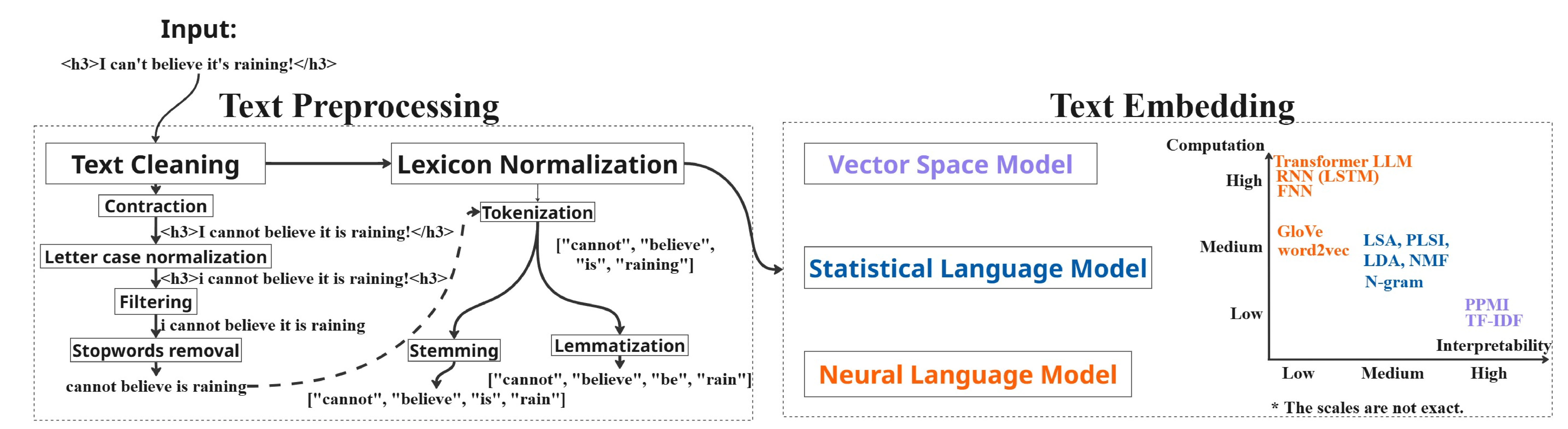 Summary of Text to Numbers Solutions
Our Methodology: Translating Text to Actuarial Insights
To overcome these hurdles, we utilize a real-world InsurTech data and employ state-of-the-art NLP techniques to enrich our models. First, we introduced a lexicon-based sentiment analysis approach to de-bias inherently flawed customer star ratings by establishing objective sentiment polarity scores. Second, to tackle the “curse of dimensionality” from thousands of raw business categories, we deployed the advanced neural embedding model, transforming more than 13,000 messy textual labels into compact, 24-dimensional, context-aware numerical features. Lastly, we explored an unsupervised topic modeling framework using LDA and RAKE to automatically map business descriptions to their appropriate North American Industry Classification System (NAICS) codes.
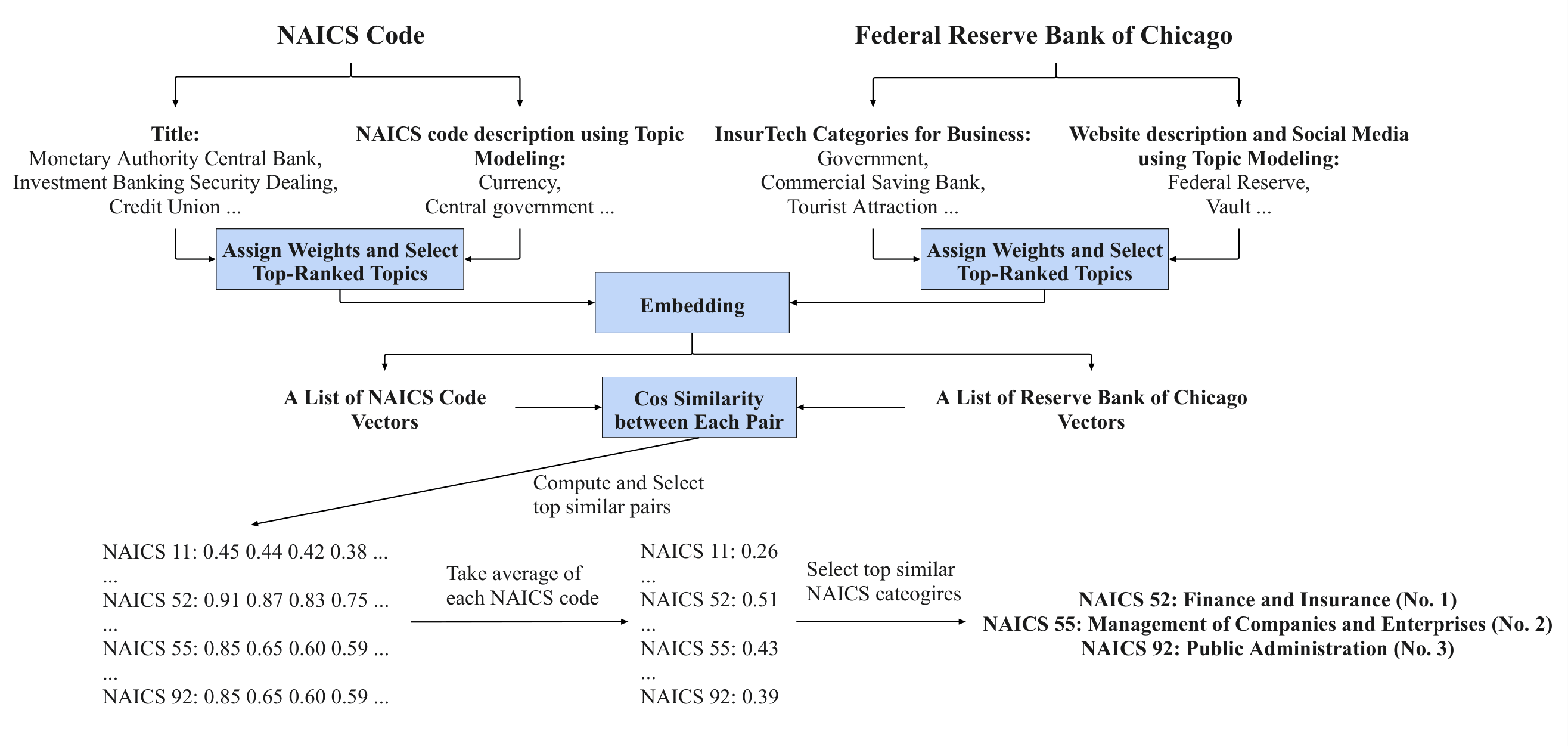 Unsupervised Industry Classification Pipeline
The Results: Better Models and Automated Workflows
Our empirical evaluations confirmed that NLP is far more than a supplementary tool in insurance; it is foundational for next-generation analytics. By replacing biased star ratings with NLP-derived polarity scores, we significantly reduced geographical and industry-specific biases, leading to fairer risk representation. When evaluating our category embeddings within a LightGBM pricing model, we found that replacing rigid category clustering with context-aware semantic embeddings improves model performance. Finally, our unsupervised industry classification framework efficiently recognized the true NAICS codes, vastly outperforming raw open-source LLMs which struggled without explicit task-specific constraints.
Recommended citation: Dong, P., Quan, Z. (2026). InsurTech innovation using natural language processing. North American Actuarial Journal, forthcoming.
Download Paper